
Overview
Story Details
Chapter Details
Overview
1. Liftoff to Uncertainty
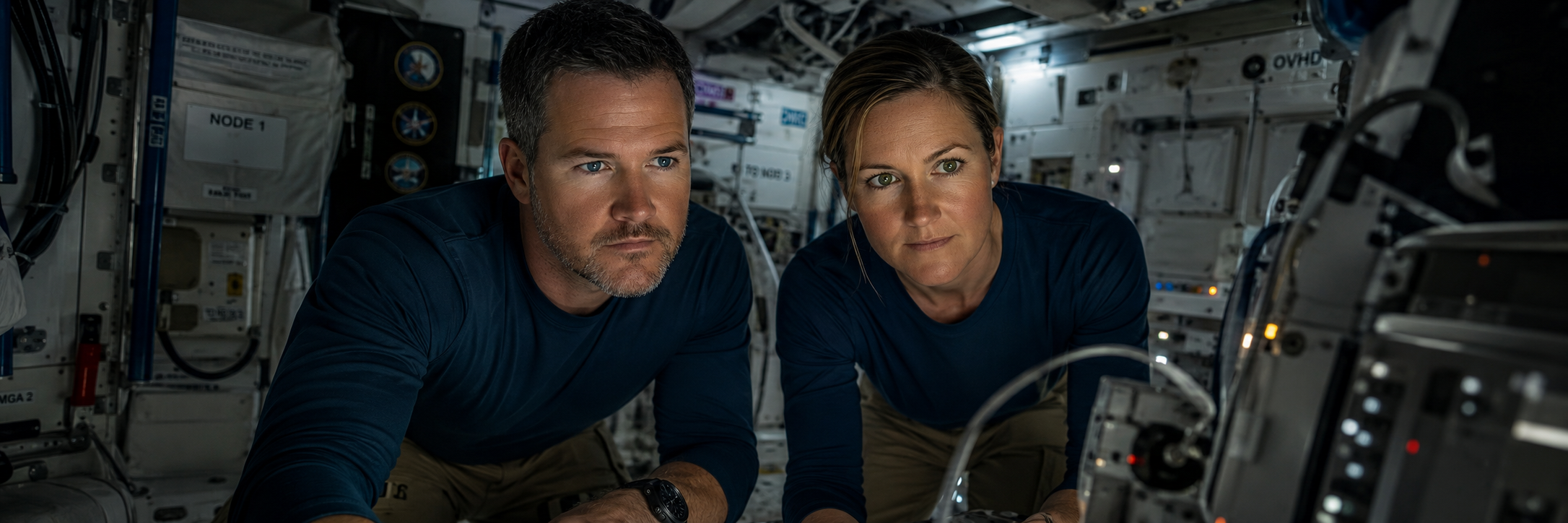
Dale and Lena embark on an 8-day mission to the ISS. Initial excitement turns to concern as technical glitches arise during their approach. As they attempt to dock, multiple systems fail, leading to a critical situation where they must make rapid decisions to avoid disaster.
Characters
Dale Walker
38, Astronaut and mission specialist with a focus on systems engineering
Lena Rhodes
34, Astronaut and aerospace engineer
Zara Chen
34, Astronaut and aerospace engineer
Marcus Blackwood
34, Aerospace engineer specializing in spacecraft design and safety protocols
Olivia Reeves
34, Astronaut and mission specialist, focusing on engineering and systems operations.
Locations
space_station
International Space Station
A unique laboratory for science and exploration in orbit.
large_vehicle
Celestial Reach
A sleek spacecraft for deep space exploration.
building_complex
Mission Control Houston
The command center for human space exploration missions.
building_complex
Odyssey Aerospace Headquarters
Hub of aerospace innovation and space mission operations.
large_vehicle
Phoenix Rescue Capsule
A lifesaving spacecraft designed for emergency evacuations.
Story Details
Basic Info
Two astronauts face an unexpected crisis when their spacecraft malfunctions, leaving them stranded on the International Space Station. As they grapple with isolation and dwindling resources, they must confront their own vulnerabilities and find strength in each other to survive.
Name:Celestial Silence: The Odyssey Begins
Status:active
URL Name:celestial-silence-the-odyssey-begins
Path:1094
Date/Time:2024-06-15, 7:30am
Completion State:complete
Story Elements
Theme:Isolation, Resilience, Technological Failure, Human Ingenuity, Psychological Endurance
Setting:International Space Station, Earth's Orbit, 2024
Categories:Space Survival, Astronaut Drama, Technological Crisis, Psychological Thriller, Human Resilience
Sequel:Following their rescue, Dale and Lena struggle to readjust to life on Earth while grappling with the psychological aftermath of their ordeal. As they become advocates for improved space safety protocols, they uncover a conspiracy within the space program that threatens future missions.
Relationships
Series:Stranded
Parent Arc:None
Child Arcs:
Characters:
Locations:
Events:
- Adrift in the Void
- Liftoff to Uncertainty
Metadata
ID:1094
Trace ID:5c02d583-593e-424b-8bf5-e29be633bc4c
Created By:1
Created At:2024-08-16 21:14:31.985531
Has Image:No
Origin Type:None
Origin ID:None
Stub Description:None
Chapter Information
Chapter 1: Liftoff to Uncertainty
2024-06-15, 7:30amTime Span: 8 hours
Opening Scene: The Celestial Reach spacecraft rumbles to life as Dale and Lena strap themselves in for what should be a routine mission to the ISS.
Events:
The chapter opens with the excitement and tension of the launch, as Dale Walker and Lena Rhodes prepare for their 8-day mission to the International Space Station. The initial stages of the flight proceed smoothly, with both astronauts demonstrating their expertise and camaraderie. As they approach the ISS, a series of minor technical glitches begin to occur, causing concern but not yet alarm. Dale and Lena work together to troubleshoot the issues, drawing on their years of training and experience. Their interactions reveal their distinct personalities: Dale's calm, methodical approach contrasting with Lena's quick-thinking adaptability. The chapter reaches its climax as the Celestial Reach attempts to dock with the ISS. Suddenly, multiple systems fail simultaneously, leaving the spacecraft drifting dangerously close to the station. Dale and Lena must make split-second decisions to prevent a collision and secure their safety, setting the stage for the challenges to come.
Actions Taken:
- Launch of Celestial Reach
- Initial smooth flight
- Occurrence of minor technical glitches
- Troubleshooting efforts
- Approach to ISS
- Multiple system failures
- Emergency maneuvers to prevent collision
Character Development:
Dale's leadership and calm demeanor under pressure revealed | Lena's quick thinking and adaptability showcased | Initial signs of their complementary working relationship emerge
Cliffhanger:
As alarms blare throughout the Celestial Reach, Dale and Lena realize with growing horror that they're locked out of the ship's main propulsion controls.
Other Notes:
Emphasize the contrast between the initial optimism of the mission and the sudden onset of crisis. Use technical details to create authenticity without overwhelming the reader.
Spinoff Ideas:
The manufacturing process of the Celestial Reach reveals potential oversights that may have contributed to the malfunction | The personal lives and relationships Dale and Lena left behind on Earth, hinting at unresolved conflicts | The political and financial pressures facing the space program that may have rushed the mission
Chapter 2: Adrift in the Void
2024-06-15, 3:45pmTime Span: 6 hours
Opening Scene: Dale and Lena frantically work to regain control of the Celestial Reach as it drifts perilously close to the ISS.
Events:
The chapter begins with Dale and Lena in crisis mode, attempting to stabilize the Celestial Reach and prevent a catastrophic collision with the ISS. Their training kicks in as they work in perfect synchronization, using every tool and technique at their disposal to regain control of the spacecraft. As the immediate danger passes, the full extent of their predicament becomes clear. The Celestial Reach's propulsion system is completely non-responsive, leaving them stranded in orbit. Dale and Lena must make the difficult decision to abandon their craft and seek refuge on the ISS, a complex and dangerous maneuver given their compromised systems. The chapter culminates in a tense space walk as Dale and Lena traverse the void between their crippled ship and the relative safety of the ISS. This perilous journey forces them to confront the vastness of space and their own vulnerability, setting the tone for the psychological challenges ahead.
Actions Taken:
- Emergency stabilization of Celestial Reach
- Assessment of system failures
- Decision to abandon ship
- Preparation for emergency space walk
- Perilous journey from Celestial Reach to ISS
Character Development:
Dale's experience as a Navy test pilot proves crucial in handling the crisis | Lena's previous experience with space walks becomes vital | The beginnings of a deep trust form between them as they rely on each other for survival
Cliffhanger:
As Dale and Lena finally enter the airlock of the ISS, a sudden power fluctuation plunges the station into darkness.
Other Notes:
Focus on the technical aspects of space travel and the physical toll of the crisis on the astronauts. Begin to explore the psychological impact of their near-death experience.
Spinoff Ideas:
The reaction and response of the ground crew at Mission Control as they witness the unfolding crisis | The history of near-misses and accidents in space exploration that inform current safety protocols | The immediate impact of the Celestial Reach's malfunction on future planned missions and public perception of space travel
Chapter 3: Sanctuary Among the Stars
2024-06-15, 9:30pmTime Span: 12 hours
Opening Scene: In the pitch-black interior of the ISS, Dale and Lena fumble to restore power and establish their new temporary home.
Events:
The chapter opens with Dale and Lena working to restore power to the ISS, their actions hampered by darkness and disorientation. As systems gradually come back online, they begin to assess their situation and the resources available to them. The reality of their predicament sets in as they realize the extent of their isolation and the challenges they face. As they settle into the station, Dale and Lena must quickly adapt to their new environment and establish a routine. They take inventory of supplies, set up communication channels with Mission Control, and begin to troubleshoot the issues with the Celestial Reach from afar. The stark contrast between the comfort of Earth and the harsh realities of space becomes increasingly apparent. The chapter concludes with Dale and Lena receiving their first status update from Mission Control. The news is grim: a rescue mission will take weeks to prepare, and in the meantime, they must conserve resources and maintain the station with limited support. The psychological weight of their isolation begins to press upon them, forcing them to confront their new reality.
Actions Taken:
- Restoration of power to ISS
- Assessment of available resources
- Establishment of communication with Mission Control
- Inventory of supplies
- Initial attempts to troubleshoot Celestial Reach remotely
- Reception of status update and timeline for rescue
Character Development:
Dale's military background surfaces as he instinctively creates structure and routine | Lena's adaptability shines as she quickly acclimates to the ISS environment | Both begin to show signs of stress as the reality of their situation sinks in
Cliffhanger:
As Dale and Lena prepare for their first sleep cycle on the ISS, a series of unexplained tremors shakes the station, hinting at new dangers to come.
Other Notes:
Emphasize the contrast between the vastness of space outside and the confined environment of the ISS. Begin to explore the psychological effects of isolation and the importance of routine in maintaining sanity.
Spinoff Ideas:
The complex logistics and planning involved in mounting a rescue mission to the ISS | The media frenzy on Earth as news of the astronauts' predicament spreads | The personal stories of the engineers and scientists working around the clock to bring Dale and Lena home safely
Chapter 4: Echoes of Home
2024-06-16, 10:00amTime Span: 24 hours
Opening Scene: Dale and Lena hover over the communication console, anxiously awaiting their first video call with family members since becoming stranded.
Events:
The chapter begins with Dale and Lena preparing for an emotional video call with their families back on Earth. As they connect, the stark reality of their situation becomes even more apparent. The conversation is a mix of reassurances, barely concealed worry, and the painful awareness of the vast distance separating them. Following the call, Dale and Lena must refocus on their survival and the maintenance of the ISS. They work through a series of complex tasks, their actions interspersed with moments of reflection on their lives back home and the uncertain future ahead. The psychological toll of their isolation begins to manifest in subtle ways, with each astronaut coping differently. The chapter reaches its climax when an urgent message from Mission Control informs them of an approaching solar flare. Dale and Lena must race against time to secure the station and themselves, knowing that the flare could disrupt their communications and potentially damage crucial systems. The impending natural disaster serves as a stark reminder of their vulnerability in the face of cosmic forces.
Actions Taken:
- Video call with family members
- Routine maintenance tasks on ISS
- Psychological coping mechanisms emerge
- Reception of solar flare warning
- Emergency preparations for solar flare impact
Character Development:
Dale struggles with feelings of guilt over the worry he's causing his family | Lena's optimism begins to fray, revealing underlying anxieties | Both astronauts start to rely more heavily on each other for emotional support
Cliffhanger:
As the solar flare approaches, the last transmission from Earth is cut off mid-sentence, leaving Dale and Lena truly alone in the vastness of space.
Other Notes:
Focus on the emotional impact of the video call and how it affects the astronauts' mindset. Use the approaching solar flare as a metaphor for the unpredictable dangers of space and the astronauts' powerlessness in the face of cosmic events.
Spinoff Ideas:
The emotional toll on the families of Dale and Lena as they grapple with the uncertainty of the situation | The scientific community's efforts to predict and mitigate the effects of solar flares on space missions | The history of solar flares and their impact on Earth's technology and previous space missions
Chapter 5: Silent Orbit
2024-06-18, 11:00amTime Span: 48 hours
Opening Scene: In the eerie quiet following the solar flare, Dale and Lena work feverishly to assess the damage and reestablish contact with Earth.
Events:
The chapter opens in the aftermath of the solar flare, with Dale and Lena surveying the damage to the ISS. Communications with Earth are down, and several critical systems are malfunctioning. The astronauts must rely on their training and ingenuity to repair what they can and adapt to the new limitations of their environment. As hours stretch into days without contact from Mission Control, Dale and Lena struggle with the psychological impact of their complete isolation. They establish a rigorous routine to maintain their mental and physical health, but the strain begins to show. Tensions rise as they disagree on how to prioritize their limited resources and dwindling supplies. The chapter reaches its climax when a minor equipment failure escalates into a life-threatening situation. Dale and Lena must work together to improvise a solution, their teamwork tested by exhaustion and frayed nerves. This crisis forces them to confront their deepest fears and rely on each other in ways they never anticipated.
Actions Taken:
- Assessment of solar flare damage
- Attempts to reestablish communication with Earth
- Emergency repairs to critical systems
- Establishment of survival routine
- Management of dwindling resources
- Collaborative problem-solving during life-threatening equipment failure
Character Development:
Dale's leadership is tested as he grapples with the weight of responsibility | Lena's resilience is pushed to its limits, revealing hidden strengths | Their relationship evolves as they learn to trust and depend on each other completely
Cliffhanger:
As Dale and Lena finally manage to restore partial communications, they intercept a fragmented transmission suggesting an unknown complication to their rescue.
Other Notes:
Emphasize the psychological impact of complete isolation and the importance of human connection. Use the silent, damaged ISS as a metaphor for the astronauts' internal struggles.
Spinoff Ideas:
The frantic efforts of the ground crew to reestablish contact with the ISS and assess the full impact of the solar flare | The global cooperation and competition among space agencies as they race to mount a rescue mission | The long-term effects of extended space travel on the human body and mind, as studied through Dale and Lena's ordeal
Chapter 6: Fractured Reflections
2024-06-20, 2:00pmTime Span: 36 hours
Opening Scene: Dale and Lena huddle around the newly repaired communication system, straining to decipher the cryptic message about their rescue.
Events:
The chapter begins with Dale and Lena attempting to piece together the fragmented transmission they received. The partial information creates more questions than answers, hinting at unforeseen complications in their rescue. This uncertainty adds a new layer of stress to their already precarious situation. As they work to maintain the station and conserve resources, the psychological toll of their ordeal becomes increasingly evident. Dale and Lena begin to experience vivid dreams and hallucinations, blurring the lines between reality and imagination. These experiences force them to confront deep-seated fears and unresolved personal issues, testing their grip on sanity. The chapter reaches its climax when a series of minor accidents and equipment malfunctions leads Dale and Lena to suspect that there might be more to their predicament than mere bad luck. The possibility of sabotage or a larger conspiracy adds a paranoid edge to their interactions, threatening the trust they've built and pushing them to their psychological limits.
Actions Taken:
- Deciphering of cryptic transmission
- Continued maintenance of ISS systems
- Management of dwindling supplies
- Experiences of vivid dreams and hallucinations
- Investigation of suspicious accidents and malfunctions
- Confrontation of personal fears and issues
Character Development:
Dale's stoic facade begins to crack, revealing deep-seated insecurities | Lena's optimism turns to skepticism as she questions the true nature of their situation | Their trust in each other is tested as paranoia sets in
Cliffhanger:
As Dale and Lena argue over the meaning of another cryptic transmission, a sudden proximity alert warns of an unidentified object rapidly approaching the ISS.
Other Notes:
Focus on the psychological deterioration of the characters and how it affects their perception of events. Use the confined space of the ISS to amplify the tension and paranoia.
Spinoff Ideas:
The debate among psychologists on Earth about the long-term mental health implications of extended space missions | The investigation into the possibility of sabotage or conspiracy within the space program | The ethical considerations surrounding the continued funding and support of manned space exploration in light of its dangers
Chapter 7: Collision Course
2024-06-21, 6:00amTime Span: 4 hours
Opening Scene: Alarms blare throughout the ISS as Dale and Lena race to the observation module to identify the approaching object.
Events:
The chapter opens with Dale and Lena in crisis mode, frantically working to identify the approaching object and assess the threat level. As they gather more data, they realize it's a large piece of space debris on a collision course with the ISS. With communications still unreliable, they must make critical decisions without the support of Mission Control. Dale and Lena quickly formulate a plan to adjust the station's orbit and avoid collision. This high-stakes operation pushes their skills and teamwork to the limit, requiring precise calculations and flawless execution. The tension builds as they race against time, their actions complicated by malfunctioning equipment and their own physical and mental exhaustion. In the final moments before potential impact, Dale and Lena are forced to attempt a risky manual maneuver. This climactic sequence tests not only their technical abilities but also their trust in each other and their own judgment. The outcome of this crisis will have far-reaching consequences for their survival and rescue prospects.
Actions Taken:
- Identification of approaching space debris
- Assessment of collision risk
- Formulation of avoidance plan
- Attempt to adjust ISS orbit
- Troubleshooting of malfunctioning equipment
- Execution of risky manual maneuver
Character Development:
Dale's decision-making under extreme pressure reveals both strengths and flaws | Lena's technical expertise becomes crucial, boosting her confidence | Their ability to work as a seamless team is put to the ultimate test
Cliffhanger:
As the immediate danger passes, Dale and Lena spot an unexpected change in the Earth's appearance below, hinting at a larger, more ominous development.
Other Notes:
Emphasize the technical challenges and physical toll of the crisis. Use the approaching debris as a metaphor for the mounting dangers and obstacles the astronauts face.
Spinoff Ideas:
The increasing problem of space debris and international efforts to mitigate this threat to space exploration | The development of advanced AI systems for space traffic management and collision avoidance | The psychological studies conducted on Earth using data from Dale and Lena's responses to crisis situations
Chapter 8: Earthbound Enigma
2024-06-24, 8:00amTime Span: 72 hours
Opening Scene: Dale and Lena peer through the ISS viewport, their faces etched with concern as they observe an unusual pattern of lights spreading across Earth's surface.
Events:
The chapter begins with Dale and Lena attempting to understand the strange phenomenon they've observed on Earth. Their efforts are hampered by intermittent communications and limited data. As they piece together fragments of information, they realize that a global crisis is unfolding below them, adding a new dimension of urgency to their own predicament. As they grapple with this revelation, Dale and Lena must also confront the rapidly deteriorating conditions on the ISS. Life support systems are failing, and their supplies are reaching critical levels. They are forced to make difficult decisions about resource allocation and risk-taking, each choice carrying potentially life-altering consequences. The chapter reaches its climax when Dale and Lena finally receive a clear transmission from Earth, detailing both the global situation and the status of their rescue mission. The news forces them to confront an impossible dilemma: their safe return might come at a cost they're not sure they're willing to pay. This moment of crisis pushes them to reevaluate their priorities and the true meaning of their mission.
Actions Taken:
- Observation and analysis of Earth phenomenon
- Management of failing life support systems
- Critical decision-making about resource use
- Reception of crucial transmission from Earth
- Confrontation of moral and ethical dilemma regarding rescue
Character Development:
Dale's sense of duty clashes with his personal ethics, forcing a deep internal conflict | Lena's scientific curiosity is tempered by a growing sense of responsibility to humanity | Their individual growth culminates in a unified philosophical stance
Cliffhanger:
As Dale and Lena prepare to make their fateful decision, a sudden power surge rocks the ISS, threatening to take the choice out of their hands entirely.
Other Notes:
Focus on the moral and ethical dimensions of the astronauts' situation. Use the contrast between their isolated predicament and the global crisis on Earth to explore themes of responsibility and the greater good.
Spinoff Ideas:
The geopolitical implications of the global crisis unfolding on Earth and its impact on international space cooperation | The ethical debates surrounding the prioritization of space missions during times of global emergency | The long-term psychological effects on astronauts who witness global events from space, unable to directly participate or assist
Chapter 9: Horizon's Edge
2024-06-27, 9:00amTime Span: 24 hours
Opening Scene: Amidst sparking panels and blaring alarms, Dale and Lena fight to stabilize the ISS's critical systems following the unexpected power surge.
Events:
The chapter opens with Dale and Lena in a desperate struggle to prevent a complete system failure on the ISS. Their actions are a race against time, requiring all of their combined skills and experience. As they work, they must also grapple with the weight of the decision they were about to make regarding their rescue and its implications for the situation on Earth. As the immediate crisis is brought under control, Dale and Lena are faced with the realization that their time on the ISS is coming to an end one way or another. They begin final preparations for either their rescue or a more drastic alternative. This process forces them to reflect on their journey, the bonds they've formed, and the profound ways in which they've been changed by their experience. The chapter reaches its climax as Dale and Lena enact their chosen plan. Whether it's a daring self-rescue attempt, a risky maneuver to assist the situation on Earth, or the arrival of the long-awaited rescue mission, the sequence is fraught with tension and uncertainty. The outcome will determine not only their fate but potentially the course of events on the planet below.
Actions Taken:
- Emergency stabilization of ISS systems
- Final decision-making regarding rescue options
- Preparation for departure from ISS
- Reflection on personal growth and changed perspectives
- Execution of chosen rescue/departure plan
Character Development:
Dale finds a new balance between duty and personal conviction, emerging as a transformed leader | Lena's experiences crystallize into a new sense of purpose, blending her scientific mind with a deeper understanding of humanity | Their shared ordeal forges a bond between them that transcends their professional relationship
Cliffhanger:
As the chapter closes, Dale and Lena face the threshold of a new journey, the Earth looming large in their view, its familiar features now holding new meaning and mystery.
Other Notes:
Bring the major themes of isolation, resilience, and human ingenuity to a culmination. Leave room for both resolution and new beginnings, reflecting the cyclical nature of exploration and human endeavor.
Spinoff Ideas:
The long-term impact of Dale and Lena's ordeal on future space exploration policies and technologies | The personal stories of the rescue team members and the challenges they faced in mounting the mission | The global response to the astronauts' return and how their experiences shape public perception of space exploration