
Overview
Story Details
Chapter Details
Overview
1. The Incident at Cotton Creek
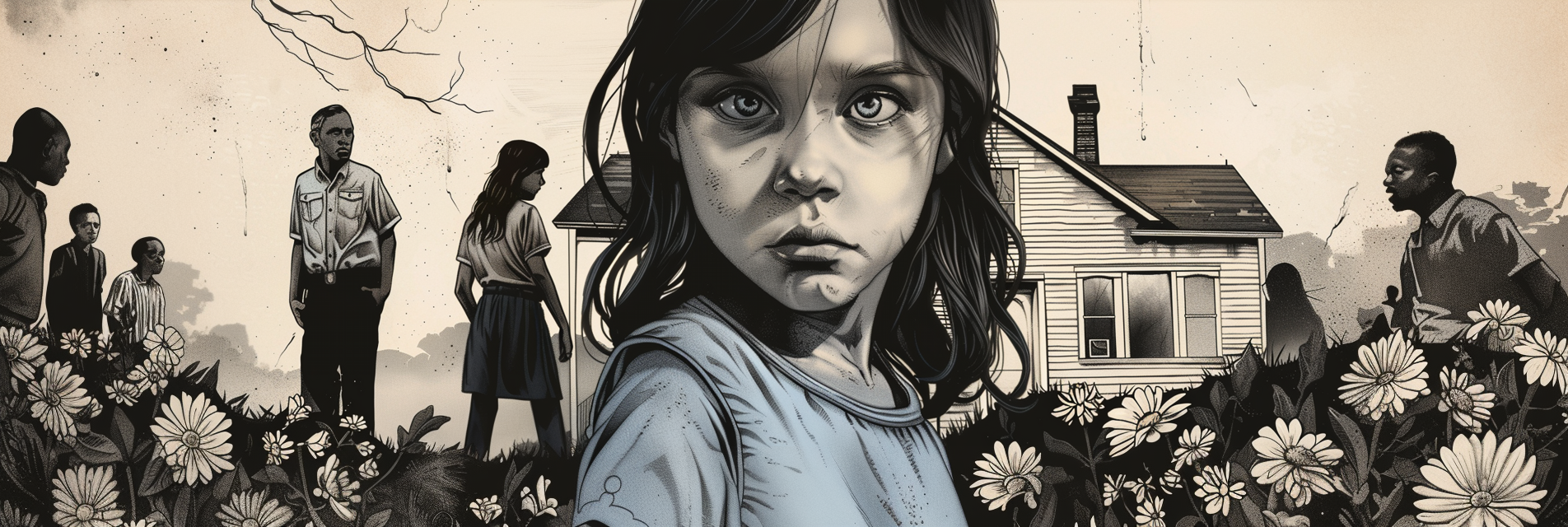
Olivia Prescott encounters Samuel Washington by Cotton Creek, sparking a friendly conversation. Their interaction is disrupted by Sheriff Tanner, who wrongfully accuses Samuel. Conflicted, Olivia rushes home to inform her father, Benjamin Prescott, leading to a community divided over the incident.
Characters
Olivia Prescott
12, Student
Samuel Washington
14, Student and aspiring writer
Judge Clarence Holbrook
55, Judge in the local court system
Sheriff Earl Tanner
45, Sheriff of Magnolia Grove, tasked with enforcing local laws and maintaining order.
Reverend Isaiah Jones
45, Reverend and community leader
Mabel Washington
67, Community organizer and elder at the local church, providing guidance and support to those in need.
Benjamin Prescott
38, Lawyer specializing in civil rights, dedicated to defending those wronged by the system.
Locations
house
Prescott family home
A warm home filled with love and books.
small_building
Washington family cabin
A rustic retreat steeped in family history and love.
large_building
Magnolia Grove Courthouse
A historic courthouse central to community justice.
park
Cotton Creek
A peaceful retreat amidst a racially divided town.
large_building
First Baptist Church
A sanctuary of faith and community in Magnolia Grove.
Story Details
Basic Info
In a segregated Southern town, a young girl's encounter with racial injustice ignites a community-wide controversy, challenging long-held beliefs and exposing hidden truths.
Name:Whispers in the Cotton Fields
Status:active
URL Name:whispers-in-the-cotton-fields
Path:530
Date/Time:1956-07-15, 2:30pm
Completion State:complete
Story Elements
Theme:racial inequality, moral awakening, social justice, courage, innocence lost
Setting:Magnolia Grove, a fictional small town in rural Alabama, 1956
Categories:civil rights, coming-of-age, courtroom drama, prejudice, moral dilemma
Sequel:The aftermath of the trial leads to increased racial tensions in Magnolia Grove, as the community grapples with changing social norms and the early stirrings of the Civil Rights Movement.
Relationships
Series:Voices for Justice
Parent Arc:None
Child Arcs:
Characters:
Locations:
Events:
- The Incident at Cotton Creek
- A Town Divided
Metadata
ID:530
Trace ID:45371360-8c16-4e88-8b09-b5071f820b4d
Created By:1
Created At:2024-07-23 01:05:40.307905
Has Image:No
Origin Type:None
Origin ID:None
Stub Description:None
Chapter Information
Chapter 1: The Incident at Cotton Creek
1956-07-15, 2:30pmTime Span: One afternoon
Opening Scene: Olivia Prescott's bare feet sink into the cool mud of Cotton Creek as she watches Samuel Washington approach from the other side.
Events:
Olivia Prescott, a curious and kind-hearted 12-year-old white girl, encounters Samuel Washington, a 14-year-old Black boy, at Cotton Creek. Despite the town's segregation laws, they strike up a friendly conversation about their shared love for reading. Their innocent interaction is abruptly interrupted by the arrival of Sheriff Earl Tanner. Sheriff Tanner, fueled by deep-seated prejudice, accuses Samuel of inappropriate behavior towards Olivia. Despite Olivia's protests, the sheriff roughly arrests Samuel, ignoring his pleas of innocence. Olivia, confused and distressed, runs home to tell her father, Benjamin Prescott, a respected lawyer in town. Word of the incident spreads quickly through Magnolia Grove, dividing the community along racial lines. Olivia's father, recognizing the injustice, decides to defend Samuel, setting the stage for a controversial trial that will challenge the town's deeply ingrained prejudices and force Olivia to confront the harsh realities of racial inequality.
Actions Taken:
- Olivia meets Samuel at Cotton Creek
- They engage in friendly conversation
- Sheriff Tanner arrives and arrests Samuel
- Olivia runs home to tell her father
- Benjamin Prescott decides to defend Samuel
Character Development:
Olivia's innocence is challenged as she witnesses racial injustice firsthand | Samuel's resilience is tested in the face of unfair accusation | Benjamin Prescott reveals his moral courage by choosing to defend Samuel
Cliffhanger:
As night falls, an angry mob gathers outside the jail, demanding Samuel's immediate punishment.
Other Notes:
Emphasize the contrast between the peaceful creek setting and the violent interruption of racial prejudice. Highlight Olivia's internal conflict as she begins to question the social norms she's grown up with.
Spinoff Ideas:
Explore the history of Cotton Creek and its significance to both white and Black communities | Delve into Sheriff Tanner's background and the experiences that shaped his prejudiced worldview | Investigate the impact of the incident on Samuel's family and their standing in the Black community
Chapter 2: A Town Divided
1956-07-16, 7:00amTime Span: One day
Opening Scene: The rising sun casts long shadows over Magnolia Grove as whispers of last night's events spread like wildfire through the awakening town.
Events:
The news of Samuel's arrest and Benjamin Prescott's decision to defend him polarizes Magnolia Grove. The white community, led by influential figures like Judge Clarence Holbrook, pressures Benjamin to reconsider his stance. Meanwhile, the Black community, fearful of repercussions, debates whether to support Samuel openly or keep silent for their own safety. Olivia, struggling to understand the complexities of the situation, overhears heated arguments between her parents. Her mother, torn between societal expectations and her husband's principles, urges Benjamin to withdraw from the case. Olivia's confusion deepens as she witnesses the strain on her family and the hostility from neighbors she once considered friends. As tensions escalate, Reverend Isaiah Jones of the First Baptist Church attempts to mediate, calling for calm and understanding. However, his efforts are met with resistance from both sides. The chapter culminates in a town meeting where the divide becomes painfully apparent, setting the stage for a bitter legal and moral battle.
Actions Taken:
- Town gossip spreads about the incident
- Benjamin faces pressure to drop the case
- Black community debates their response
- Olivia overhears parental arguments
- Reverend Jones attempts mediation
- Contentious town meeting occurs
Character Development:
Benjamin's resolve is tested as he faces social and professional backlash | Olivia begins to grasp the complexity of racial issues | Reverend Jones emerges as a voice of reason amidst chaos
Cliffhanger:
As the town meeting erupts into chaos, a brick shatters the courthouse window, silencing the crowd and foreshadowing the violence to come.
Other Notes:
Focus on the ripple effects of Benjamin's decision throughout the community. Highlight the internal conflicts of various characters as they grapple with their beliefs and social pressures.
Spinoff Ideas:
Examine the history of racial tensions in Magnolia Grove and how they've shaped the town's social dynamics | Explore the role of the church in the community and its influence on social issues | Investigate the economic disparities between the white and Black communities in Magnolia Grove
Chapter 3: Echoes of the Past
1956-07-17, 3:00pmTime Span: One afternoon and evening
Opening Scene: Olivia clutches her father's hand tightly as they walk down the dusty road towards the Washington family cabin, the weight of their mission hanging heavily in the air.
Events:
Benjamin and Olivia visit Samuel's family to discuss the case and gather information. They meet Mabel Washington, Samuel's strong-willed grandmother, who shares stories of past injustices faced by their family. These revelations open Olivia's eyes to a history she never knew existed in her town. As they talk, a group of white men drive by, shouting threats and racial slurs. The incident terrifies Olivia and reinforces the danger Samuel and his family face. Benjamin, visibly shaken but determined, promises to do everything in his power to secure Samuel's freedom and safety. Returning home, Olivia and Benjamin find their own house vandalized with hateful messages. This personal attack forces Olivia to confront the harsh realities of standing up for what's right in a prejudiced society. The chapter ends with Benjamin making a late-night phone call to an old friend from law school, seeking advice and support for the challenging trial ahead.
Actions Taken:
- Benjamin and Olivia visit the Washington family
- Mabel shares family history
- White men threaten the Washingtons
- Prescott home is vandalized
- Benjamin calls a friend for legal advice
Character Development:
Olivia gains a deeper understanding of racial injustice through Mabel's stories | Benjamin's determination grows in the face of personal attacks | Mabel Washington emerges as a pillar of strength and wisdom
Cliffhanger:
As Benjamin ends his phone call, a shadowy figure is seen lurking near the Prescott's back porch, eavesdropping on the conversation.
Other Notes:
Emphasize the contrast between Olivia's sheltered upbringing and the harsh realities she's now facing. Use Mabel's stories to provide historical context for the racial tensions in Magnolia Grove.
Spinoff Ideas:
Delve into Mabel Washington's past and her experiences with racial injustice | Explore the history of interracial friendships and relationships in Magnolia Grove | Investigate the role of local law enforcement in perpetuating or challenging racial stereotypes
Chapter 4: The Weight of Truth
1956-07-18, 9:00amTime Span: Two days
Opening Scene: The Magnolia Grove Courthouse looms before Olivia, its imposing facade a stark reminder of the battle that lies ahead.
Events:
As the pre-trial hearings begin, Olivia attends the proceedings, witnessing firsthand the mechanics of the justice system. She's shocked by the blatant bias shown by Judge Holbrook and the prosecution. Benjamin skillfully challenges the charges, revealing inconsistencies in Sheriff Tanner's account of the incident. Outside the courthouse, tensions flare as protesters from both sides clash. Olivia, caught in the middle, experiences the raw emotions driving the conflict. She overhears conversations that expose deep-seated fears and prejudices, forcing her to question beliefs she once took for granted. The situation takes a dangerous turn when Samuel's family receives death threats. Reverend Jones organizes a secret meeting of the Black community to discuss protective measures. Olivia, following her father, accidentally stumbles upon this gathering, gaining insight into the fear and resilience of a community under siege.
Actions Taken:
- Pre-trial hearings begin
- Benjamin challenges Sheriff Tanner's account
- Protesters clash outside courthouse
- Samuel's family receives death threats
- Secret meeting of Black community occurs
- Olivia accidentally witnesses the meeting
Character Development:
Olivia's understanding of justice and injustice deepens | Benjamin showcases his legal acumen and moral fortitude | Reverend Jones emerges as a leader in crisis
Cliffhanger:
As the secret meeting disperses, Olivia is discovered hiding in the church basement, raising questions about her loyalties and the potential consequences of her accidental intrusion.
Other Notes:
Focus on the legal intricacies of the case while balancing it with the human drama unfolding outside the courthouse. Use Olivia's perspective to highlight the absurdity and injustice of the segregation laws.
Spinoff Ideas:
Explore the history of the Magnolia Grove Courthouse and past racial trials | Investigate the underground networks supporting the Black community in times of crisis | Examine the role of children in the Civil Rights Movement and how they navigated complex racial issues
Chapter 5: Crossroads of Conscience
1956-07-20, 10:00amTime Span: One day
Opening Scene: Olivia stands frozen in the church basement, her heart pounding as dozens of eyes turn to her, a mix of fear and suspicion etched on every face.
Events:
The discovery of Olivia at the secret meeting throws both communities into turmoil. The Black community fears retaliation, while some in the white community see it as proof of the Prescotts' 'race betrayal'. Olivia, overwhelmed by the consequences of her actions, must navigate the intensifying storm. Benjamin faces a difficult decision when he's offered a deal: drop Samuel's case in exchange for leniency towards Olivia's 'trespassing'. This moral dilemma forces him to weigh his professional ethics against his daughter's safety. Olivia, overhearing this, grapples with guilt and the realization of the far-reaching implications of the case. As pressure mounts, unexpected allies emerge. Mabel Washington risks her safety to publicly defend Olivia, while a young white journalist begins to question the official narrative, hinting at Sheriff Tanner's history of racial profiling. These acts of courage inspire others to speak up, slowly shifting the town's dynamics.
Actions Taken:
- Olivia's presence at the meeting is revealed
- Benjamin is offered a deal to drop the case
- Mabel publicly defends Olivia
- Young journalist investigates Sheriff Tanner
- Community members begin to speak up
Character Development:
Olivia confronts the consequences of her actions and develops a deeper sense of responsibility | Benjamin faces a crucial test of his principles | Mabel demonstrates courage by defending Olivia publicly
Cliffhanger:
As night falls, a cross is set ablaze on the Prescotts' front lawn, its fiery glow illuminating the faces of shocked neighbors gathered in the street.
Other Notes:
Highlight the internal struggles of various characters as they're forced to choose sides. Use the burning cross as a powerful symbol of the escalating conflict and the price of standing up for justice.
Spinoff Ideas:
Delve into the history of cross burnings in the South and their impact on communities | Explore the role of journalism in exposing racial injustice during the Civil Rights era | Examine the experiences of white allies in the Civil Rights Movement and the backlash they faced
Chapter 6: The Turning Tide
1956-07-21, 7:00amTime Span: Three days
Opening Scene: Smoke still lingers in the air as Olivia helps her father clear the charred remains of the cross from their lawn, each piece a stark reminder of the hatred they face.
Events:
The cross burning galvanizes the community in unexpected ways. Some of Benjamin's staunchest opponents, shocked by this act of terror, begin to reconsider their positions. The young journalist's article exposing Sheriff Tanner's history of racial bias is published, causing a stir and leading to calls for an investigation. As the trial date approaches, Olivia takes a bold step by reaching out to her classmates, sharing her experiences and challenging their preconceptions. Her actions inspire a group of young people, both Black and white, to organize a silent protest outside the courthouse. Meanwhile, Benjamin uncovers evidence that could exonerate Samuel, but obtaining it would require breaking ethical boundaries. This dilemma forces him to confront the limitations of the legal system in achieving true justice. The chapter culminates in a tense confrontation between Benjamin and Judge Holbrook, where the true extent of the town's deeply rooted prejudices is laid bare.
Actions Taken:
- Community reacts to cross burning
- Journalist's article is published
- Olivia reaches out to classmates
- Youth organize silent protest
- Benjamin discovers crucial evidence
- Confrontation between Benjamin and Judge Holbrook occurs
Character Development:
Olivia transforms from a passive observer to an active agent for change | Benjamin grapples with the moral complexities of pursuing justice within a flawed system | Judge Holbrook's façade of impartiality crumbles, revealing his deep-seated biases
Cliffhanger:
As Benjamin leaves the judge's chambers, he receives an anonymous note warning him that Samuel's life is in imminent danger.
Other Notes:
Focus on the ripple effects of individual actions in shifting community perspectives. Highlight the generational divide in attitudes towards racial justice, with the younger generation emerging as a force for change.
Spinoff Ideas:
Explore the long-term impact of youth activism in the Civil Rights Movement | Investigate the ethical dilemmas faced by lawyers defending civil rights cases in the South | Examine the role of anonymous allies and informants in civil rights struggles
Chapter 7: In the Shadow of Fear
1956-07-24, 11:30pmTime Span: One night
Opening Scene: The jail's shadows stretch long and ominous as Benjamin approaches, the anonymous note burning a hole in his pocket.
Events:
Acting on the warning, Benjamin rushes to the jail to ensure Samuel's safety. He arrives to find Sheriff Tanner and a group of deputies preparing to move Samuel to an undisclosed location, claiming concerns for his safety. Suspicious of their motives, Benjamin demands to accompany them. What follows is a tense night-time journey through back roads, with Benjamin struggling to ensure Samuel's rights are protected. During the trip, Samuel shares his fears and hopes with Benjamin, humanizing himself in a way that deepens Benjamin's resolve to see justice done. Unknown to them, Olivia has followed her father. Witnessing the precarious situation, she makes a risky decision to alert Reverend Jones and the Washington family. This sets in motion a community response that will have far-reaching consequences for the trial and the town's future.
Actions Taken:
- Benjamin rushes to the jail
- Sheriff attempts to move Samuel
- Tense journey through back roads
- Samuel opens up to Benjamin
- Olivia follows and alerts others
- Community mobilizes in response
Character Development:
Benjamin's commitment to justice is tested in a high-stakes situation | Samuel reveals his vulnerability and humanity | Olivia takes a significant risk, showcasing her growing courage and conviction
Cliffhanger:
As dawn breaks, Benjamin and Samuel arrive at their destination - the state capital - where they're met by a crowd of reporters and a surprise witness who could change everything.
Other Notes:
Use the night-time journey to create a sense of suspense and danger. Highlight the growing bond between Benjamin and Samuel, and how this personal connection reinforces Benjamin's commitment to the case.
Spinoff Ideas:
Investigate historical cases of prisoners being moved or hidden to obstruct justice | Explore the network of safe houses and allies that supported civil rights activists | Examine the role of state versus local authorities in civil rights cases
Chapter 8: The Scales of Justice
1956-07-25, 9:00amTime Span: Two days
Opening Scene: The courtroom buzzes with tension as Olivia slips into a back row, her eyes fixed on Samuel at the defendant's table, his fate hanging in the balance.
Events:
The trial begins with the prosecution painting Samuel as a dangerous element in society, playing on racial fears. Benjamin counteracts with a powerful opening statement, challenging the town to live up to its ideals of justice and equality. As witnesses take the stand, including Sheriff Tanner and Olivia, the full story of what happened at Cotton Creek unfolds. Benjamin's cross-examinations expose inconsistencies and prejudices, slowly shifting the narrative. The surprise witness - a elderly white woman who saw the entire incident - provides testimony that contradicts the Sheriff's account. Outside, the youth-led silent protest grows, attracting national media attention. This external pressure, combined with the revelations in court, begins to sway public opinion. The chapter ends with closing arguments, as Benjamin makes an impassioned plea for justice that forces everyone in the courtroom to confront their own biases.
Actions Taken:
- Trial begins
- Prosecution and defense present their cases
- Witnesses testify
- Surprise witness contradicts Sheriff
- Silent protest grows
- Benjamin delivers powerful closing argument
Character Development:
Samuel maintains his dignity in the face of character attacks | Olivia shows maturity and courage on the witness stand | Benjamin delivers the performance of his career, fueled by personal conviction
Cliffhanger:
As the jury files out to deliberate, a commotion erupts outside the courthouse, and the sound of breaking glass echoes through the courtroom.
Other Notes:
Focus on the legal drama while also capturing the human emotions at play. Use the trial as a microcosm of the larger struggle for civil rights, highlighting how individual actions can challenge systemic injustice.
Spinoff Ideas:
Explore famous civil rights trials and their impact on public opinion | Investigate the experiences of Black defendants in the Jim Crow South | Examine the role of juries in civil rights cases and how jury selection influenced outcomes
Chapter 9: A New Dawn
1956-07-27, 10:00amTime Span: One day
Opening Scene: Olivia's hand trembles as she grasps her father's, the jury foreman rising to deliver a verdict that will change their lives forever.
Events:
The verdict is read: Samuel is found not guilty. The courtroom erupts in a mix of joy, relief, and anger. As Samuel embraces his family, Olivia realizes that while a battle has been won, the war against injustice is far from over. Outside, the crowd's reaction is volatile. Supporters celebrate, while others protest the verdict. In the chaos, a group of angry men attempt to attack Samuel, but are stopped by an unlikely alliance of white and Black townspeople, including some of Benjamin's former critics. In the aftermath, Magnolia Grove begins the painful process of self-reflection and healing. Olivia, now seeing her town with new eyes, commits herself to continuing the fight for equality. The chapter ends with a quiet moment between Olivia and Samuel at Cotton Creek, their friendship a symbol of hope for a more just future.
Actions Taken:
- Jury delivers not guilty verdict
- Courtroom reacts to decision
- Crowd outside becomes volatile
- Attempted attack on Samuel is thwarted
- Town begins process of reflection
- Olivia and Samuel meet at Cotton Creek
Character Development:
Olivia emerges from the trial with a new sense of purpose and understanding | Samuel faces the future with cautious optimism | The town of Magnolia Grove takes its first tentative steps towards change
Cliffhanger:
As Olivia and Samuel part ways at the creek, they notice a group of both Black and white children playing together on the other bank, hinting at the possibility of a more integrated future.
Other Notes:
Emphasize that while justice was served in this case, it's just one step in a long journey. Highlight the mixed reactions to show the complexity of changing deeply ingrained societal norms.
Spinoff Ideas:
Explore the long-term impacts of the trial on Magnolia Grove's racial dynamics | Investigate the challenges faced by integrated communities in the South | Examine the role of youth in carrying forward the legacy of the Civil Rights Movement